


Not because I’m smart.
Because I’m building a system that operates itself - finds its own holes, plugs them, reports what it did, and gets better. That’s the whole point. Not an automation. An operating system.
Today was Phase 1 of making that real. 15 tasks. A migration checklist to take my agent infrastructure from a scrappy prototype to a sovereign multi-tenant Agent OS. The kind of thing Astra scoped at 1-3 days.
We did it in 4.5 hours. With the gym, groceries, and a 45-minute meeting in between.
Here’s what happened.
I use three AI tools. Not because it’s cool. Because each one does something I can’t do alone.
AIdam runs on my Hetzner server. 39 cron-driven agents seed data, generate content, monitor revenue, and watch each other. It’s the machine that runs the business while I sleep.
Grokbot is a desktop app on my Mac that leverages Cursor. It comes with my Cursor subscription. Code builder. It sees every repo, writes fixes, and pushes pull requests. Can’t touch my server - I reload code manually. Separation of concerns built in.
Astra is Astra 6 by ChatGPT. Runs in ChatGPT’s desktop app in Codex mode. My operations lead. It plans, executes through my terminal, and verifies everything against live evidence.
If you’re paying $20/month for Cursor, you already have access to Grokbot. If you’re paying $20/month for ChatGPT, you have Astra.
These aren’t secret enterprise tools. They’re consumer subscriptions. I just started playing with them, pointed them at things I was already doing, and kept going. That’s the whole secret.
Use everything at your disposal.
So here’s how today actually worked.
I pointed Astra at my GitHub repos and my server and gave it a specific prompt: audit this infrastructure against a 58-task migration checklist. Find what’s broken. Find what’s drifting. Find what’s invisible. Fix it. Verify every fix with live evidence.
It crawled the repos. It checked every website. It queried every database. It read every cron config, every backup script, every Docker volume. And it came back with a full diagnostic of what was actually happening on my server - not what I thought was happening, not what some summary claimed was happening. What was actually there.
Then we went to work.
My backups were broken. Three months of nightly backups, encrypting perfectly, shipping to offsite storage. 59 backup files. Not one of them could be restored. The decryption key was never installed in the keyring. If my server had died, I would have lost everything. Several essential databases on the infrastructure weren’t being backed up at all - just not in the script. We fixed it. Key imported, databases added, full restore tested end-to-end. Download, decrypt, extract, verify. It works now.
14 of my 20 directory sites had no canonical tags. Google couldn’t determine the canonical URL. The city pages we spent weeks generating? Not in any sitemap. Invisible to search engines. The ones that did have canonicals pointed city pages to the homepage - telling Google that 100 city pages were duplicates of the root. We merged 22 pull requests across 20 repos to fix it.
My health monitoring was writing to a dead database. Every health check for months - silently failing. The system reported, “7 tenants Ready.” It was reading stale air. New tables created in the correct project. The monitoring will actually monitor now.
14 copies of my tenant registry had drifted. Different versions of the truth across 14 workspaces. 19 orphaned Docker volumes from dead jobs. A legacy database table with no constraints. All cleaned up.
The data seeder had no explicit conflict resolution at the database level. We added ON CONFLICT constraints, per-tenant transaction isolation, and formal idempotency tests. Run it twice, same data. Run it concurrently; no collisions.
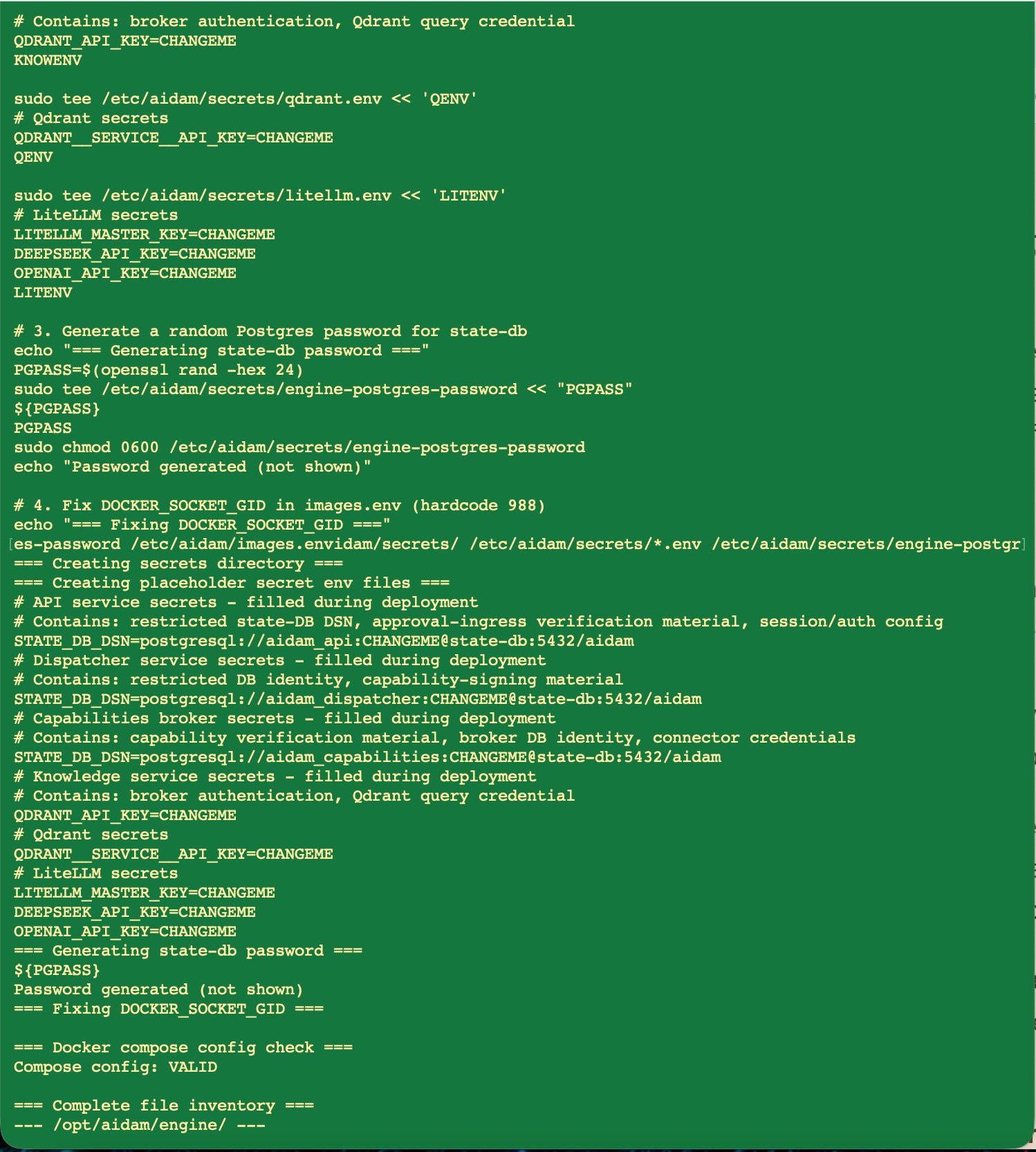
And I built the foundation for Phase 2. The /opt/aidam directory structure. 41,000 files staged. Migration map written. Every path documented, every hash verified. The sovereign engine has somewhere to live.
Here’s the math. A human working alone - even a good sysadmin - would need a week for this. Manually check 20 websites. Write code changes across 20 repos. Audit 22 database tables. Download and decrypt encrypted backups. Hunt down 14 drifted config files. Clean up 19 orphaned volumes. Stage 41,000 files. Write a secrets registry. Document every privileged container.
That’s not 4.5 hours. That’s a week. Maybe more.
I did it in 4.5 hours because I had three AI tools, each with a job, and I know how to point them at problems.
Here’s where this is going.
I’ve engineered a structure for AI agents to work on that I haven’t seen anybody else publicly talk about. Three agents, each with a defined role, each holding the others accountable. A runtime that executes. An auditor that builds and fixes. An operations lead that plans, verifies, and holds everything to evidence.
But that’s just the foundation. What I’m productizing isn’t “AI automation.” Not a course. Not 10 prompts.
An operating system. Point it at any business. It learns about itself - what’s broken, what’s drifting, what’s invisible to Google, what’s not backed up. It fixes what it can. It flags what it can’t. It reports what it did. And it gets better every cycle.
Astra said the business can’t fail. She’s right - but only because the system is being built to catch its own failures before they become failures. Today proved it. The holes were there for months. We found all 15 in one afternoon and plugged them.
Phase 2 is the sovereign engine. The part where the system doesn’t just fix what I tell it to - it finds the problems on its own, proposes solutions, gets my approval, and executes. The divergent loop. The revenue sensor. The self-improvement cycle.
That’s next.
No guru track. No “10 prompts.” If you want the stack, the failures, and the decisions, you’re in the right place.
Free is the field report. Paid is how I actually built it.
The Studio Zero runs 39 production agents on his own revenue businesses and shows his work. studiozerohq.com
Technical uptime is a prerequisite for survival, yet it remains only the starting point for actual recovery. When the infrastructure stabilizes, the true work of restoring trust and operational continuity begins. You have correctly identified that the business cannot fail, and that reality forces a shift from simple data retrieval to full organizational resilience. Restoring files is a mechanical task, but restoring a company requires a coherent plan for communication, stakeholder management, and reputation control. We often focus on the bits and bytes while overlooking the human systems that keep the entity functioning during a crisis. True recovery is about the speed at which the organization regains its ability to execute its mission.
https://cyrilsimonnet.substack.com/p/backups-restore-files-they-do-not?utm_source=substor&utm_medium=substack&utm_campaign=comment